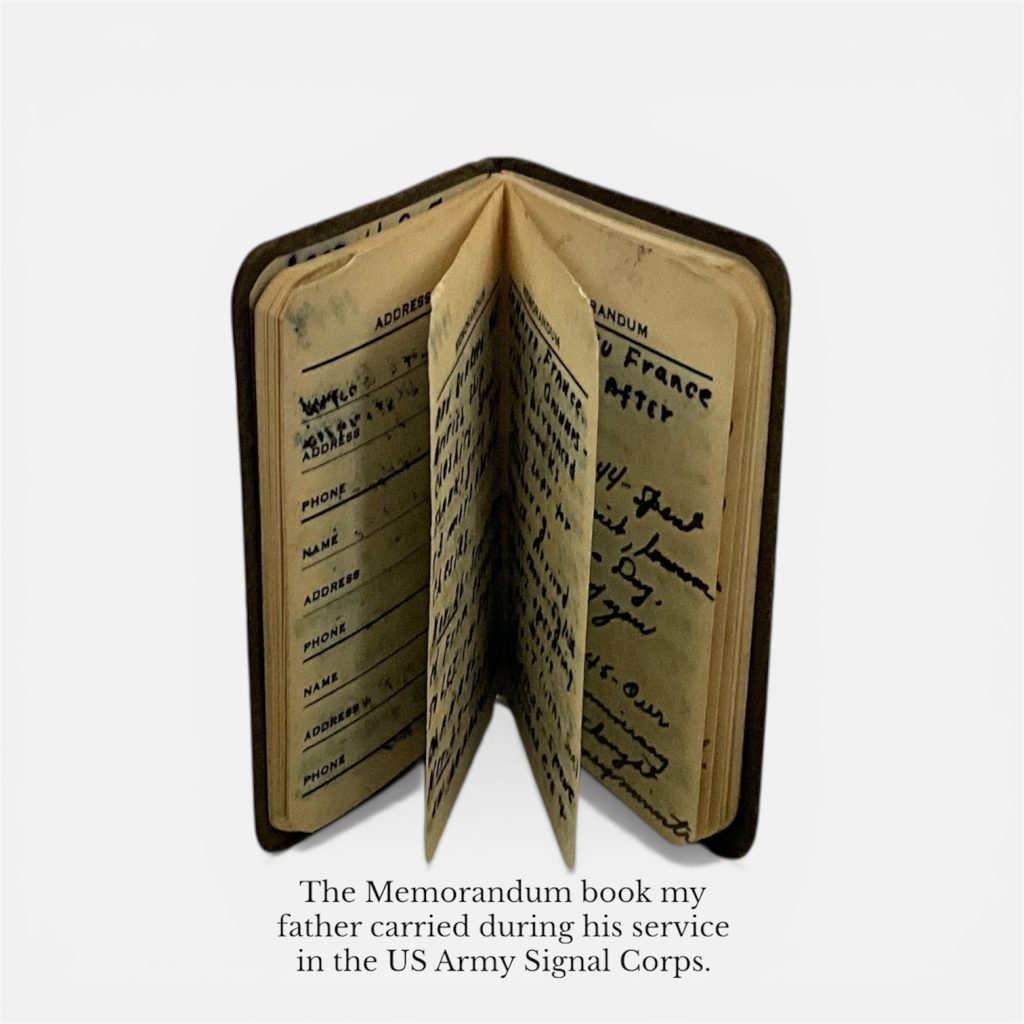
Chronicle IV the Journey
Signal Corps Memorandum Book – November 26-27, 1944
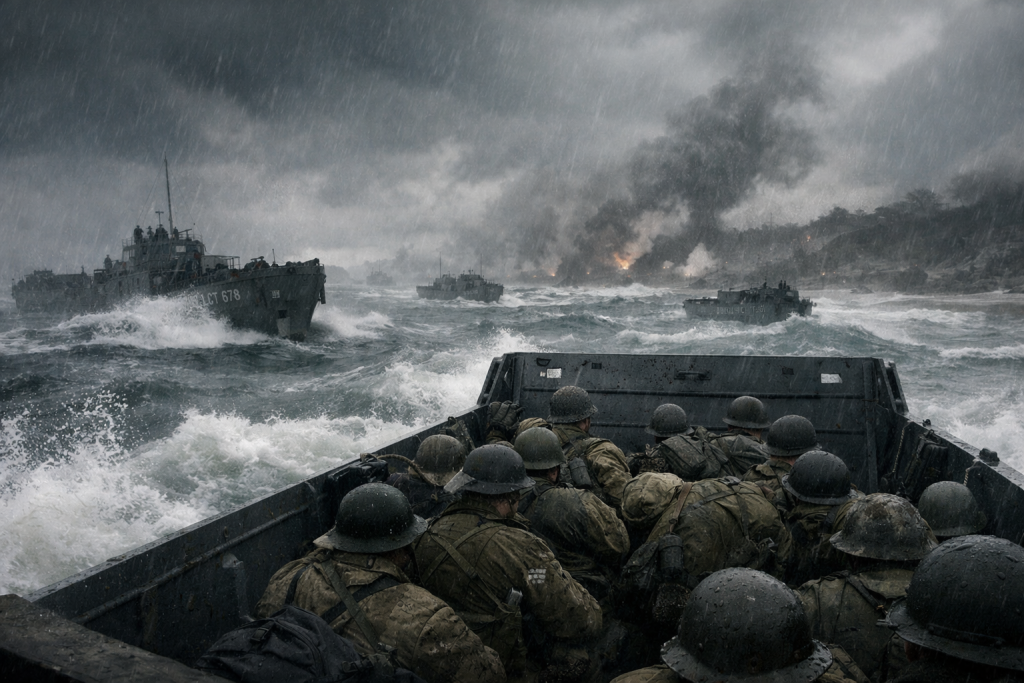
Artistic reconstruction of Allied land craft approaching the Normandy coast during rough English Channel weather in World War II. Used here to illustrate the conditions soldiers experienced when crossing to France. By late November 1944, Allied forces had already secured much of Normandy following the landings on Utah Beach and Omaha Beach during D-Day.
Artifact – The Memorandum Page Signal Corps. Memorandum Book – November-December 1944
The following text is a transcription of my father’s handwritten entries. The left page begins with the continuation of a note from the previous page of the notebook.
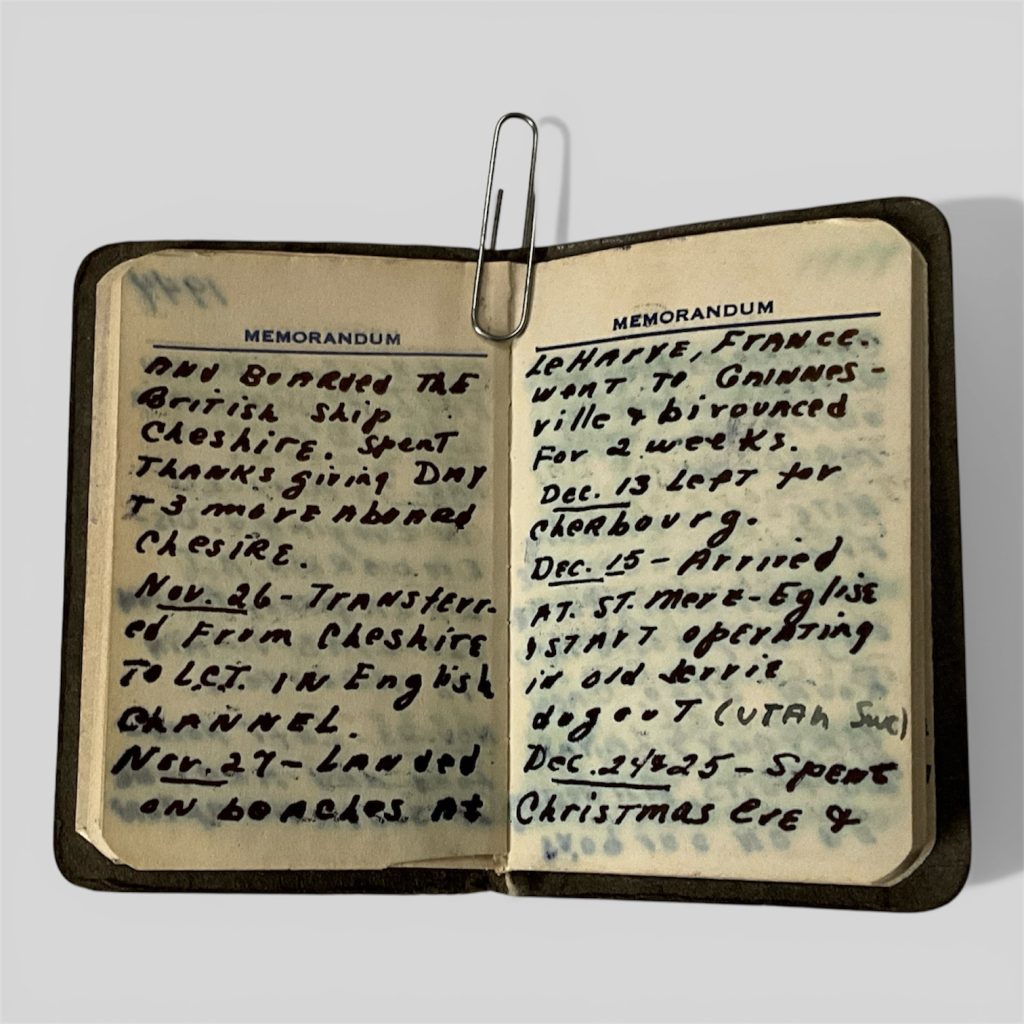
(continuation from previous page)
- … and boarded the British ship Cheshire.
- Spent Thanksgiving Day and three more days aboard Cheshire.
- Nov. 26 – Transferred from Cheshire to *LCT in the English Channel.
- Nov. 27 – Landed near Le Havre, France.
- *Bivouacked at Gonfreville for two weeks.
- Dec. 13 – Left for Cherbourg.
- Dec. 15 – Arrived at St. Mère-Église (Utah Sector). Start operation in old *Jerrie dugout
- Dec. 24-25 – Spent Christmas Eve & …
Memorandum Transcript
Terms from the Memorandum
*LCT (top image) – On November 26, 1944, my father recorded being transferred from the British ship Cheshire to an LCT (Landing Craft, Tank) in the English Channel. These landing craft were commonly used during the war to move troops and equipment from transport ships to the Normandy beaches. LCT was typically about 120-190 feet long and could carry:
- several tanks
- trucks
- or dozens of soldiers.
The ride was very rough in heavy seas, my father would tell us how very sick he had gotten and all of the other soldiers who were also getting seasick during the crossing. They had a flat bottom and a front ramp that dropped down so vehicles and troops could drive directly onto the shore.
*Jerrie Dugout – “Jerrie” was a common Allied nickname for German soldiers during World War II. A “Jerrie Dugout” referred to a German bunker, foxhole or underground shelter built for protection. Allied troops sometimes used these abandoned positions after capturing the area.
**Bivouacked – To bivouac meant to camp outdoors temporarily. Soldiers often slept in tents, foxholes or improvised shelters while stationed in the field.
Historical Context
November 26-27, 1944
By late November 1944, Allied forces had already secured the Normandy region following the massive invasion earlier that year during D-Day.
Ports along the French coast were now critical for supplying the advancing Allied armies pushing toward Germany.
One of these ports was Le Havre, which had been heavily bombed and captured by Allied forces in September 1944. By the time your father arrived there in November, the city had become an important logistics and transportation hub for troops and equipment moving through northern France.
Signal Corps soldiers played a crucial role in this effort. Members of the United States Army Signal Corps were responsible for installing and maintaining communication networks that connected field units with command headquarters.
These communications systems included:
- field telephones
- radio networks
- miles of wire linking command posts and operational units
Without these systems, commanders would have been unable to coordinate troop movements or respond quickly to changing battlefield conditions.
When your father crossed the English Channel and came ashore near Le Havre, he entered a landscape still marked by the fighting of the previous months. Destroyed buildings, temporary camps, and military depots were common throughout the region.
Yet even in these difficult conditions, Signal Corps personnel continued their work, ensuring that Allied forces remained connected as operations moved inland.
Signal Corps Field Equipment – Typical Gear Carried by a Communications Soldier
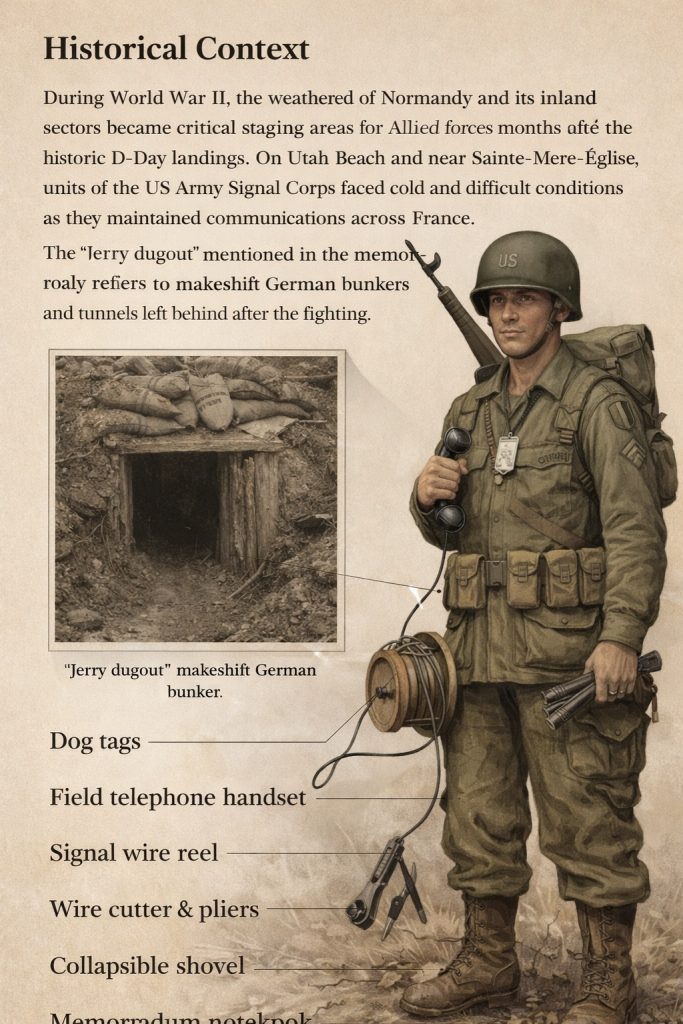
Soldiers serving in the United States Army Signal Corps were responsible for maintaining battlefield communications during World War II.
Field technicians often carried wire reels, telephone handsets, pliers, and cutting tools used to install communication lines between command posts and frontline units. These tools allowed Allied forces operating near Utah Beach and Sainte-Mère-Église to remain connected as operations moved inland.
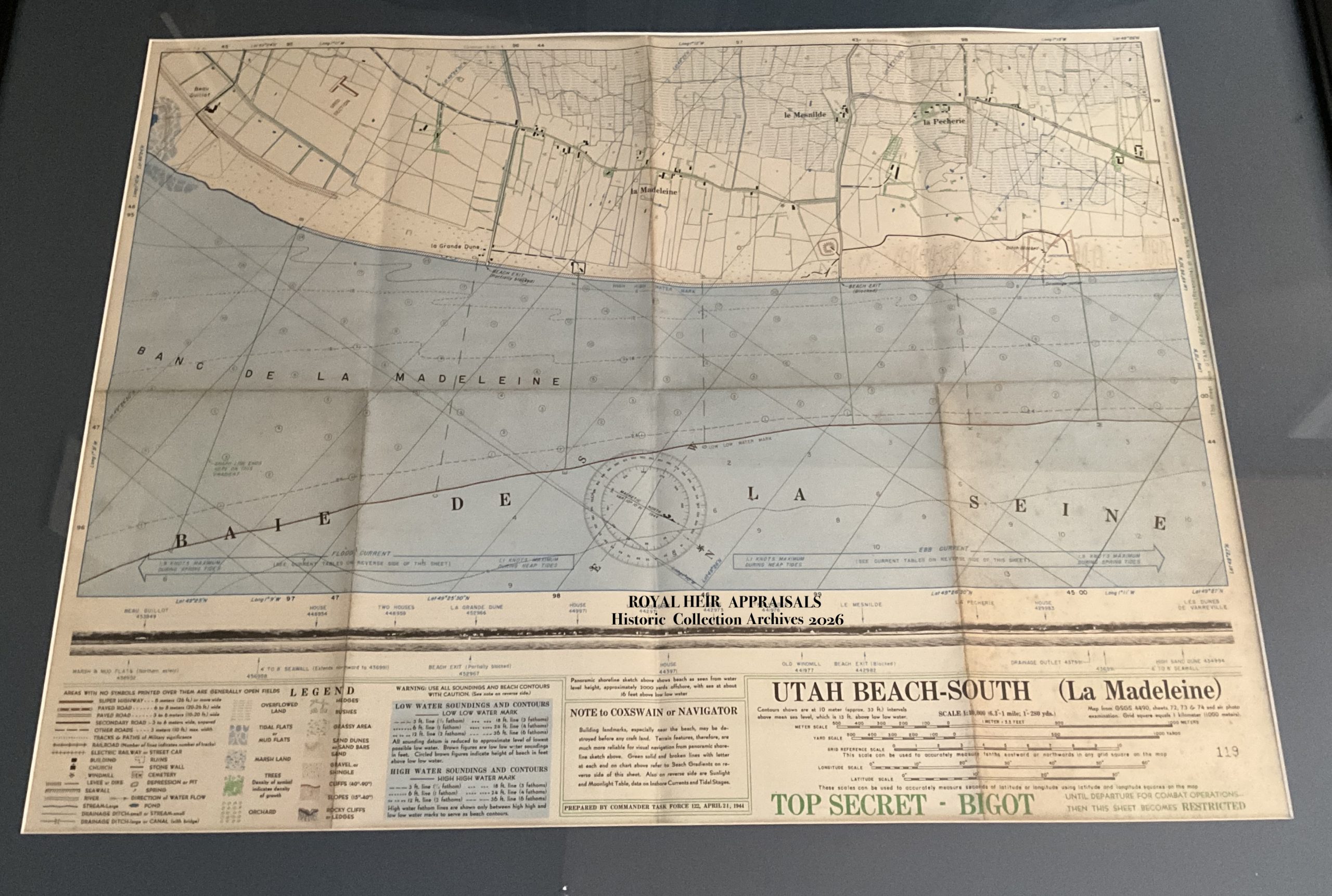
Artifact – The Operational Map of Utah Beach Sector
(Original map in preservation frame)
This is the operational map my father carried while serving in Normandy. The original folds remain from where it was carried in the field. The map covers the sector near Utah Beach, an area closely connected to the operations of the 101st Airborne Division after D-Day.
Tracing the Journey
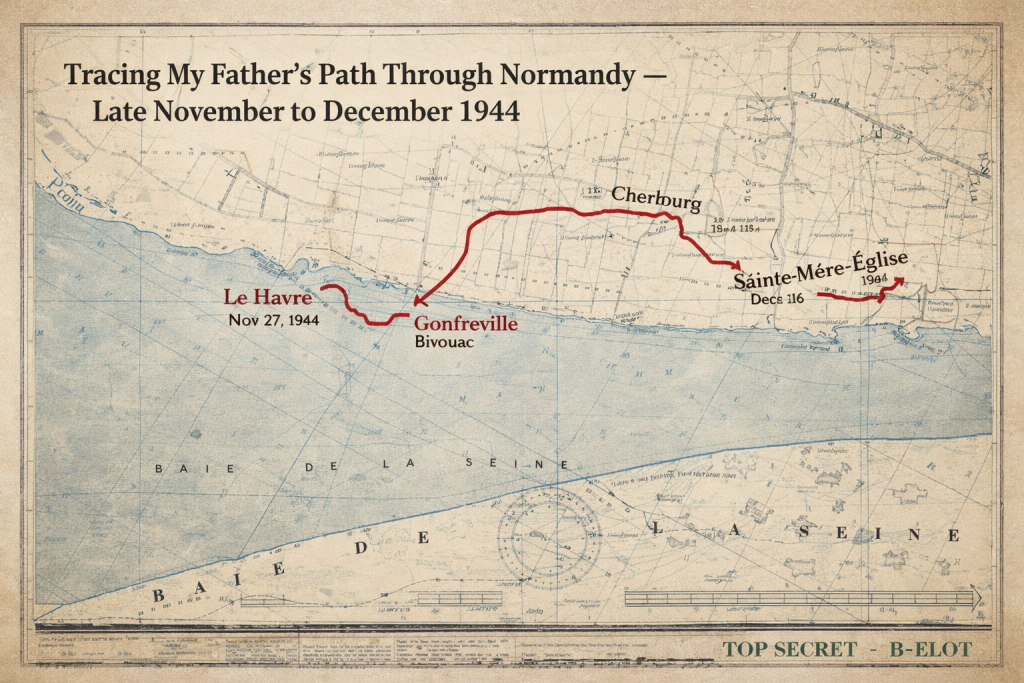
Using locations recorded in my father’s memorandum, I traced the route of his movement through Normandy: Le Havre → Gonfreville → Cherbourg → Sainte-Mère-Églis
For most of my life, I never saw this memorandum book. My father never spoke about it, and these pages remained folded away for decades.
I only discovered it after I closed his estate. Among the boxes I brought home to sort through, I began uncovering my father’s preserved artifacts from World War II.
Now, reading these first entries written in November 1944, I realize something remarkable.
This is where his journey began.
And this is where the Chronicle of his legacy begins as well.
The story continues.