
THE CHRONICLE SERIES – The Sunday AM Paperboy
America Through the Family Lens
The Sunday Paper Boy Delivery-Sunday Ritual
Before smartphones buzzed on nightstands…
before breaking news alerts flashed across screens…
before social media connected neighborhoods…
America woke up to the sound of a bicycle rolling down the sidewalk.
For millions of families throughout the 1950s, the paperboy became part of the rhythm of everyday American life.
Every Sunday morning before sunrise, young boys pedaled through quiet neighborhoods tossing rolled newspapers onto front porches with remarkable accuracy.
But the newspaper was never simply “news.”
It was ritual.
The smell of fresh ink.
The sound of turning newspaper pages.
Coffee brewing in the kitchen.
Children reaching for the Sunday Funnies first while fathers unfolded headlines at the breakfast table.
Inside those newspapers lived:
- world events,
- baseball box scores,
- grocery coupons,
- department store advertisements,
- television listings,
- weather forecasts,
- and the stories shaping America itself.
But perhaps the most important story…
…was the boy delivering the paper.
In the late 1950s, many paperboys earned only about $5–$10 per week delivering newspapers before and after school.
They woke before sunrise.
Folded newspapers by hand.
Organized comic sections.
Collected subscriptions door-to-door.
And rode bicycles through rain, snow, and summer heat long before most of the neighborhood had even turned on a kitchen light.
What looked like a simple newspaper route was quietly shaping:
- future providers,
- future business owners,
- future community leaders,
- and eventually…
- the future Patriarchs of American families.
The future leaders of American families were not built in boardrooms first.
They were built in neighborhoods.
As America moved through the 1950s, newspapers became woven into the rhythm of everyday life across the Northeast.
In Boston, fathers carried home the Boston Globe.
In New Jersey, commuters grabbed copies of The Star-Ledger on their way home from the city.
And throughout New York, the evening edition of the New York Post became part of the daily routine for countless working families.
Every evening, commuters poured through bus terminals, train stations, and crowded city sidewalks where newspaper vendors hustled to catch the attention of tired workers heading home.
Newspapers waved high in the air.
Headlines shouted from busy corners.
And voices echoed through the city:
“GET YOUR PAPER HERE!”
Men tossed quarters onto the newsstands or directly into the coin aprons worn by newspaper vendors before boarding buses and trains for home.
For one generation of American fathers, the newspaper became part of the daily transition from:
- the working world,
to - the family world waiting at home.
By evening, folded newspapers landed on living room couches and kitchen tables all across America — signaling that the workday was over and family life had begun.
But by Sunday evening…
the pace of the weekend slowly changed.
The newspapers were folded and set aside.
The dishes from Sunday supper were cleared.
Baths were finished.
Pajamas were on.
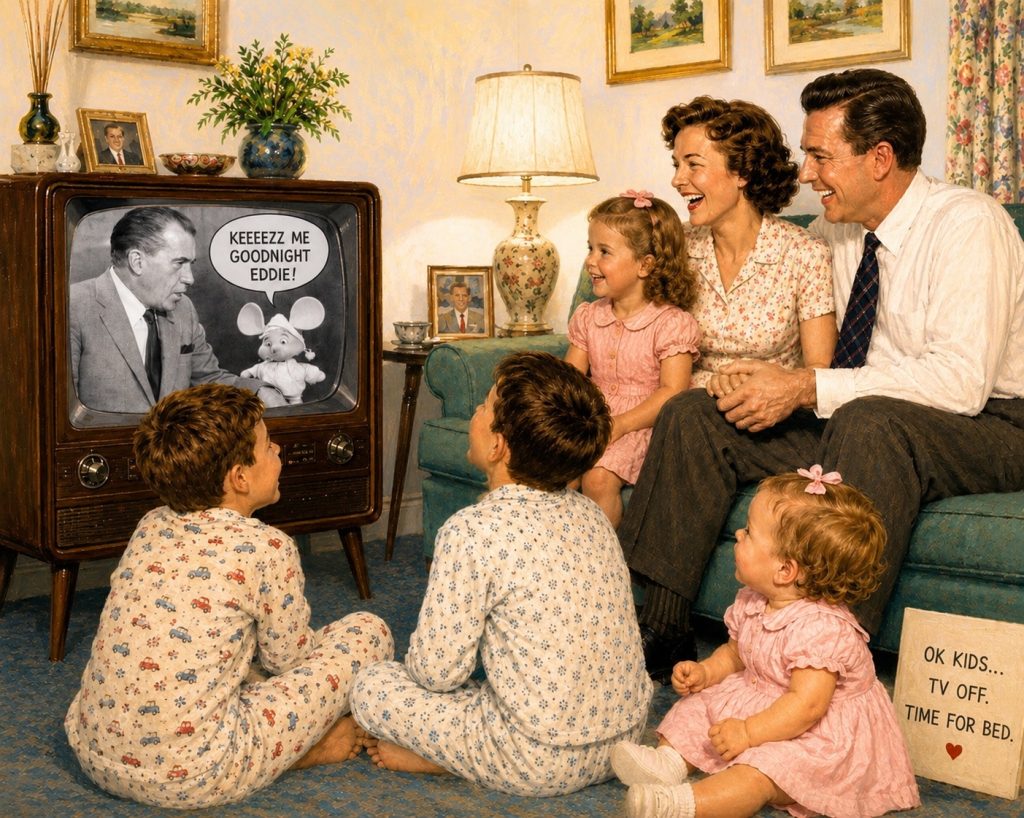
And across America, families gathered together once again — this time around the television.
TV Guides rested beside living room chairs marking the night’s programs ahead.
Jiffy Pop crackled on stovetops as aluminum foil domes slowly rose over the burner.
Children stretched out across carpeted floors while parents settled into their familiar evening chairs.
And in homes across America, only a handful of television channels quietly connected an entire nation together at the exact same hour.
Sunday mornings may have belonged to the newspaper…
…but Sunday nights belonged to television.
Somewhere in kitchens across America, Jiffy Pop crackled on stovetops while the faint smell of burnt popcorn kernels drifted into living rooms just as Ed Sullivan came on television.